
Great Pistol Shooters Aren’t Born.
They’re Trained
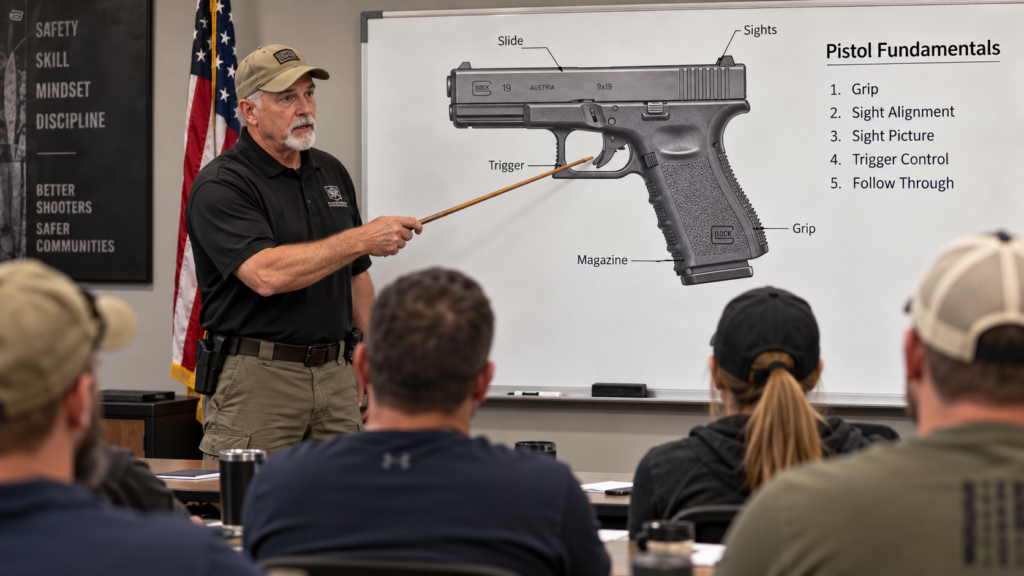 Becoming a great pistol shooter doesn’t happen by accident. It isn’t a matter of luck, natural talent, or simply firing thousands of rounds of ammunition. There is a process. That process begins with learning, practicing, and continually improving the pistol shooting fundamentals.
Whether you’re a beginner or an experienced shooter, the fundamentals remain the same. Exceptional shooters apply them consistently and efficiently.
Here’s something every shooter should understand: Practice alone doesn’t make you better. Practicing correctly does.
What Are the Nine Fundamentals
of Pistol Shooting?
The nine fundamentals are stance, grip, sight alignment, sight picture, breathing control, trigger control, muzzle control, follow-through, and recovery.
Each contributes to accuracy, consistency, and handgun control. Together, they form the foundation of good marksmanship.
These principles are especially important during beginner pistol training. Developing correct habits from the beginning is easier than correcting deeply established mistakes later.
1. Stance: Build a Consistent Foundation
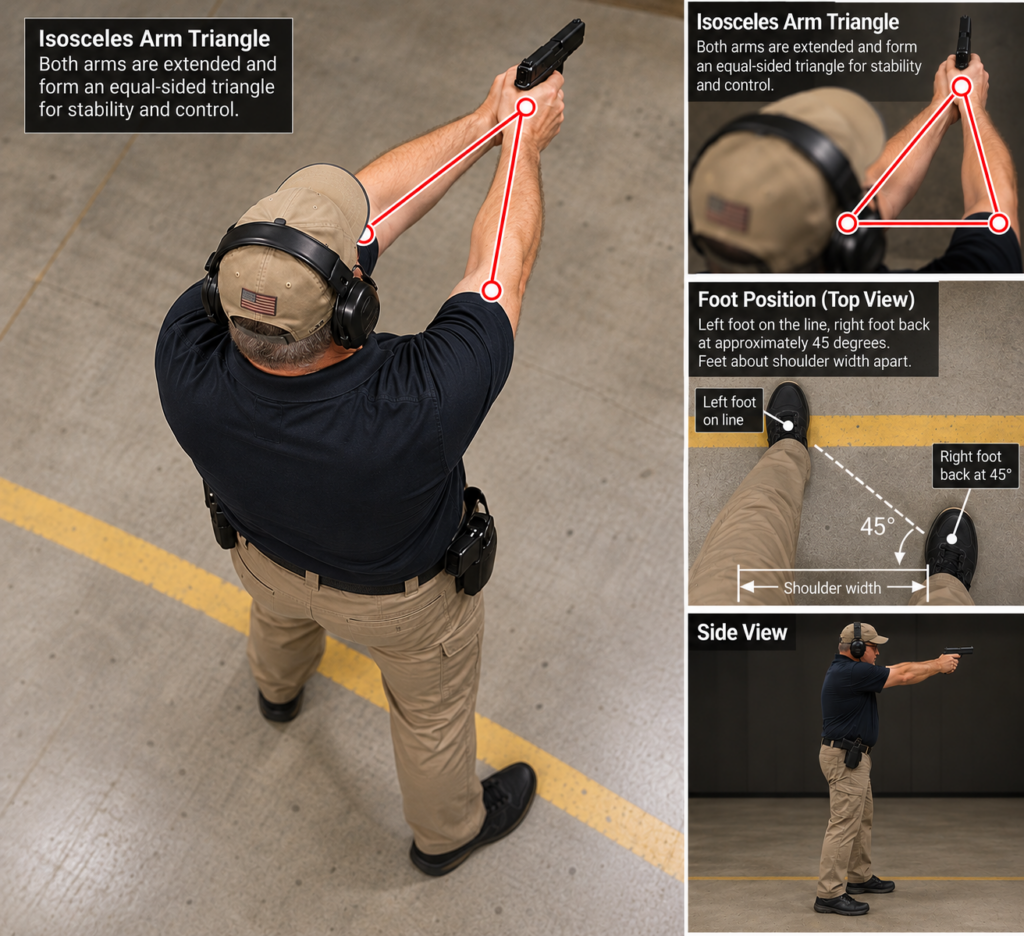 A stable, balanced stance provides the foundation for controlling your pistol.
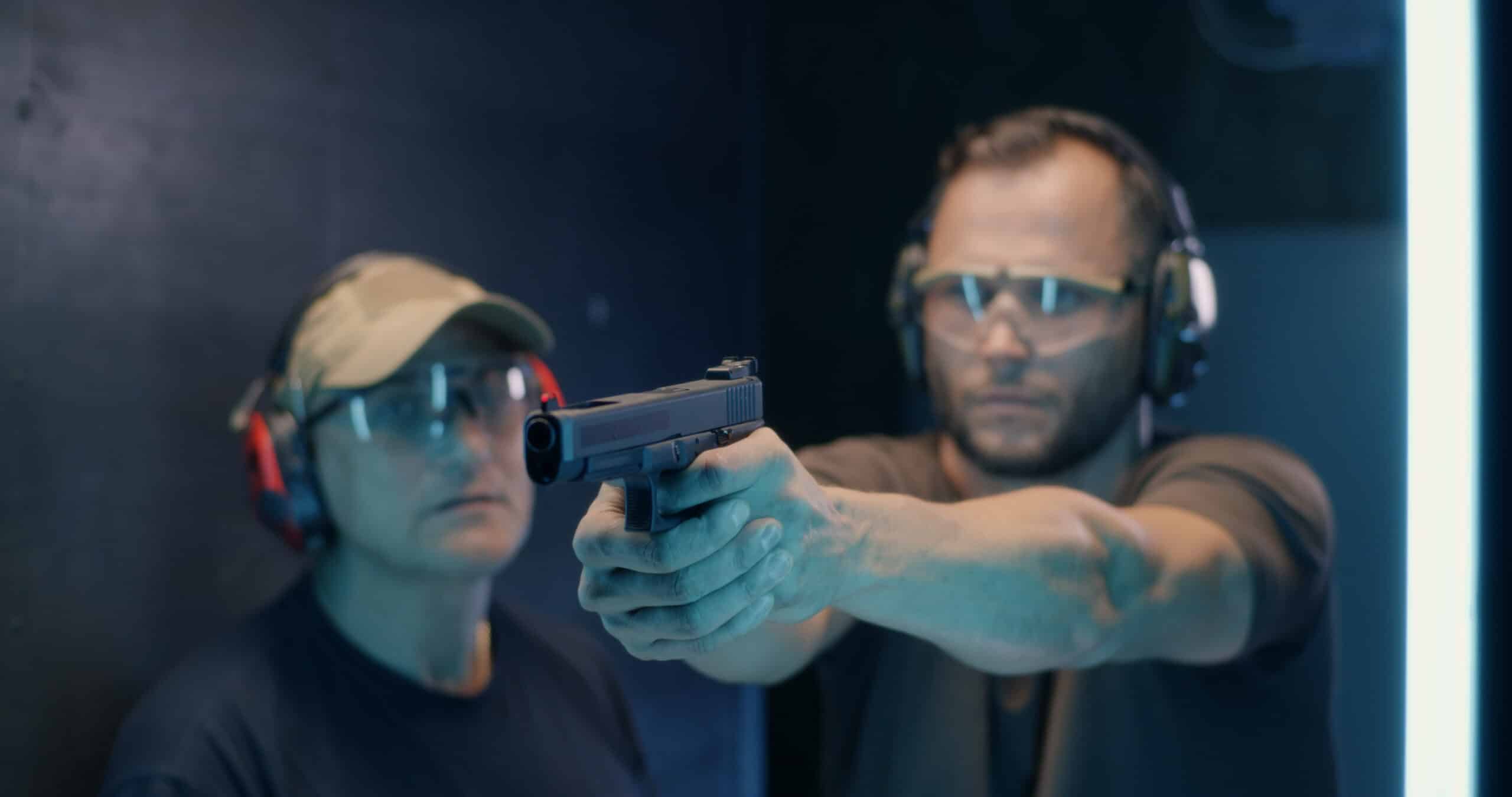
One effective approach places your support-side foot slightly forward. Position your strong-side foot farther back and angle it approximately 45 degrees. Your support-side toes can point toward the target.
With both hands on the pistol, extend your arms forward to form an isosceles triangle. You can lock your elbows or maintain a slight bend, depending on your comfort and physical characteristics.
This stance helps establish a repeatable relationship between your body, the pistol, and the target.
Consistent positioning helps the handgun return to approximately the same location each time. As a result, you spend less time making unnecessary sight corrections.
2. Grip: Control the Pistol Before and After Recoil
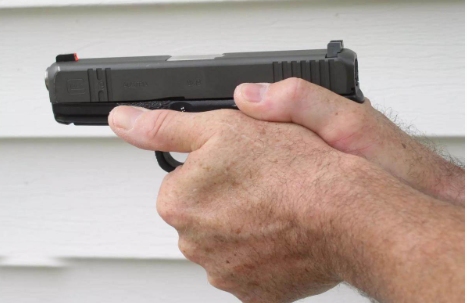 Your grip connects your hands to the handgun.
Establish a high grip. Position the web between your thumb and index finger firmly against the beavertail or upper backstrap.
Both hands should maintain consistent contact with the pistol. One useful coaching guideline applies approximately 80 percent of gripping pressure with the support hand.
The strong hand supplies the remaining 20 percent. However, individual requirements vary.
This approach emphasizes support-hand control while reducing unnecessary tension in the hand operating the trigger.
On a semiautomatic pistol, keep both thumbs on the same side and clear of the moving slide. Never position your support-hand thumb behind the slide.
Grip becomes especially important during recoil. The objective isn’t merely to control the first shot.
A consistent grip also helps the sights return predictably for subsequent shots.
3. Sight Alignment: Understand Correct Alignment
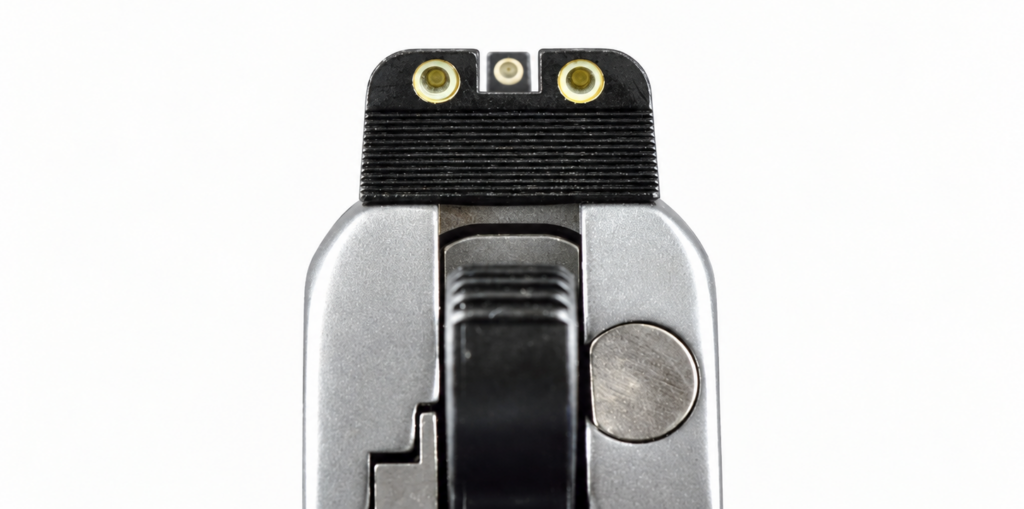 With conventional iron sights, center the front sight within the rear sight notch.
The front sight’s top should align with the rear sight’s top. Maintain equal amounts of visible space on both sides of the front sight.
During traditional precision shooting, concentrate your visual attention on the front sight. The target will generally appear somewhat blurred.
Even small alignment errors become increasingly significant as distance increases.
Red-dot optics require a different visual approach.
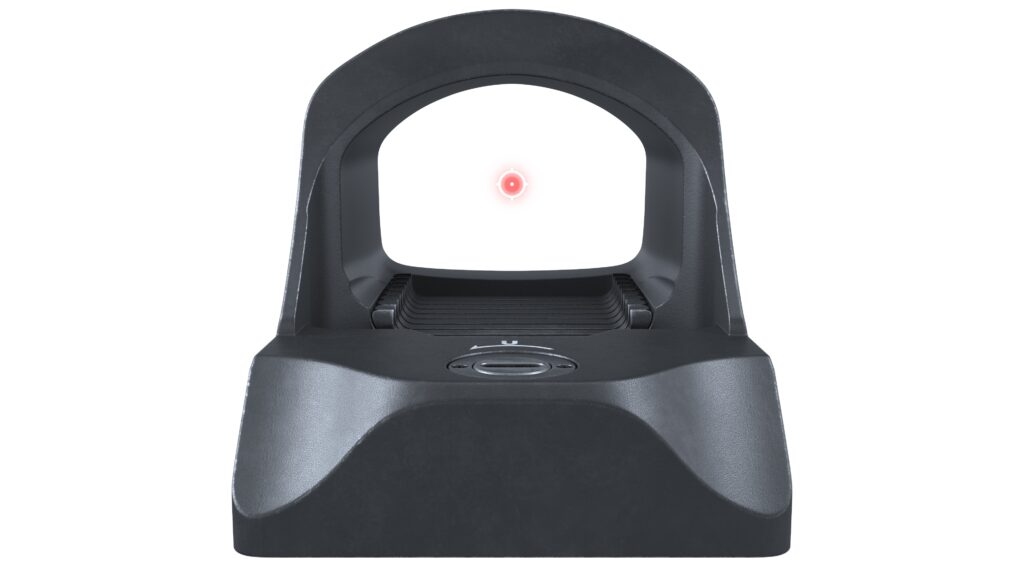 With a properly zeroed red-dot sight, focus on the target. The illuminated dot appears superimposed over the intended point of impact.
Keeping both eyes open helps preserve visual awareness and supports target-focused aiming.
4. Sight Picture: Put the Sights on the Target
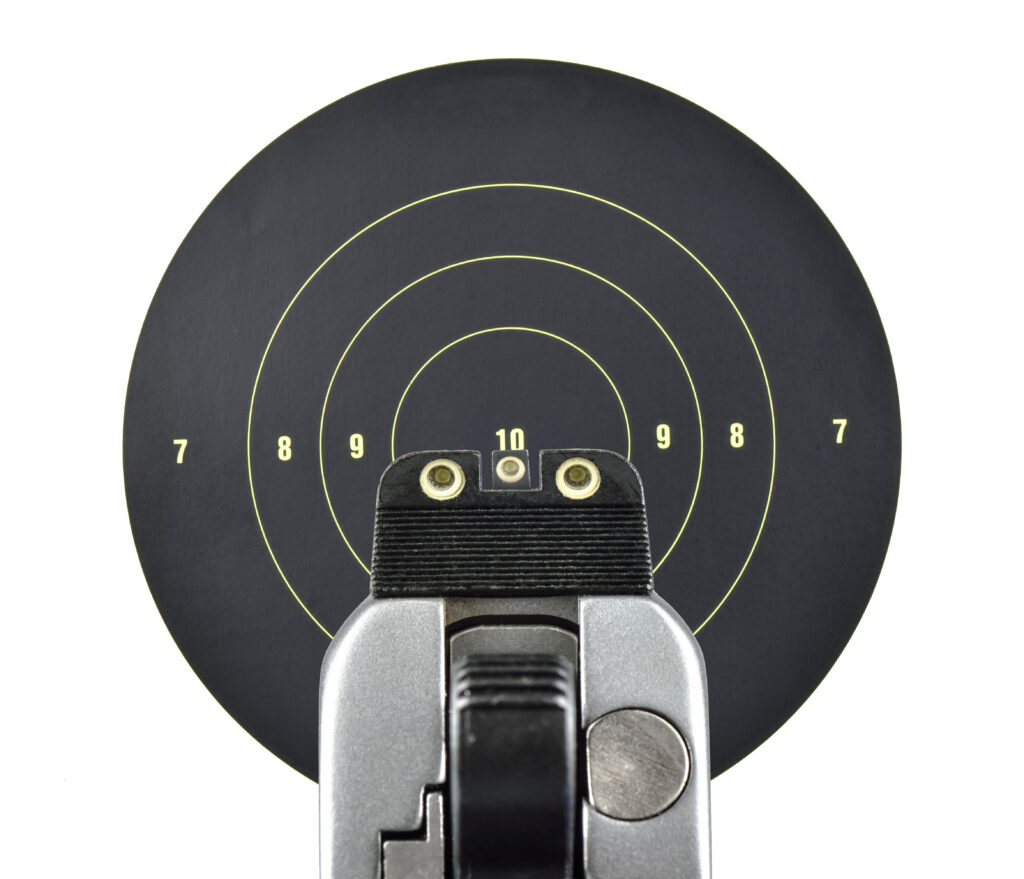 Sight alignment and sight picture serve different purposes.
Alignment establishes the correct relationship between the front and rear sights. Picture places those aligned sights on the intended target.
With conventional iron sights, position the properly aligned sights on your desired aiming point.
With a red-dot optic, place the dot over that point while maintaining target focus.
Remember that a perfect trigger press cannot compensate for an incorrectly established sight picture.
5. Breathing Control: Minimize Unnecessary Movement
Breathing naturally produces movement throughout your body, including your arms and handgun.
During deliberate precision shooting, take a normal breath. Then use a comfortable natural respiratory pause to help minimize movement.
During faster shooting, controlled breathing remains important. Avoid excessive tension or unnecessarily holding your breath.
The purpose isn’t to eliminate breathing. Instead, prevent it from interfering with consistent performance.
6. Trigger Control: Don’t Disturb the Sights
 Trigger control is one of the most important elements of accurate shooting.
The objective is to operate the trigger without disturbing the pistol’s alignment.
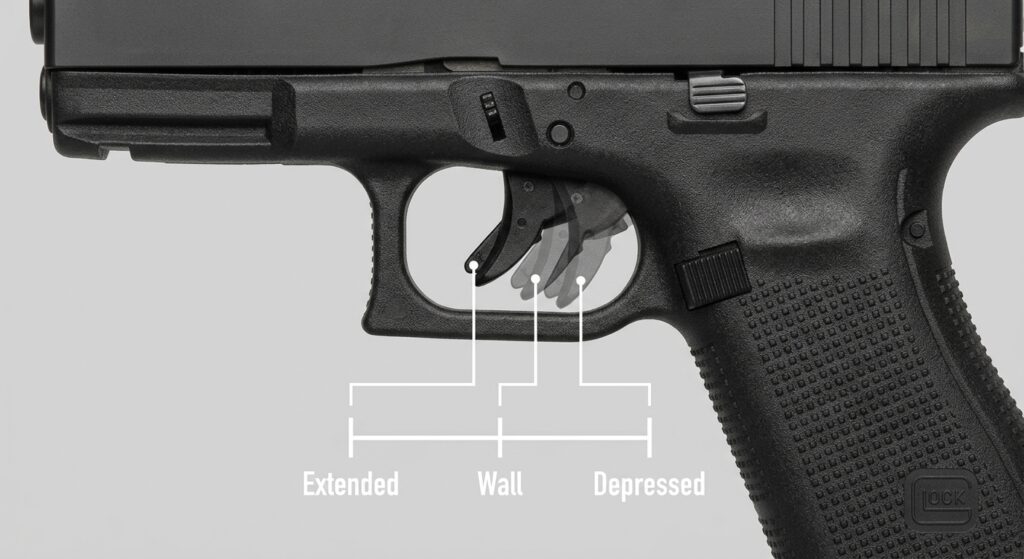
During deliberate precision shooting, gradually apply pressure and take up the trigger’s initial slack. The slack is gone when you reach the trigger wall. This is the position where the trigger has resistance to moving further rearward.
Controlled additional pressure at this point causes the shot to break without a sudden jerk or unnecessary movement. For deliberate accuracy practice, avoid trying to force the shot to occur at a particular instant.
After firing, a controlled trigger release allows the mechanism to reset. It resets at the position that you felt the wall. When firing multiple shots, do not allow the trigger to go forward of the wall / reset position. Understanding this reset point helps develop consistent trigger operation.
Once shooting stops, remove your finger from the trigger and keep it outside the trigger guard, along side of the slide.
Remember, excellent stance, grip, and sight alignment accomplish little if poor trigger control moves the handgun off target.
7. Muzzle Control: Maintain Directional Control
Muzzle control is both a safety responsibility and an essential part of consistent handgun handling.
Always maintain awareness of where the muzzle points. Keep it directed in a safe direction throughout handling and practice.
Proper muzzle control also supports consistency between the pistol’s orientation and the intended target.
This responsibility doesn’t begin or end with the trigger press. It continues throughout the entire shooting process.
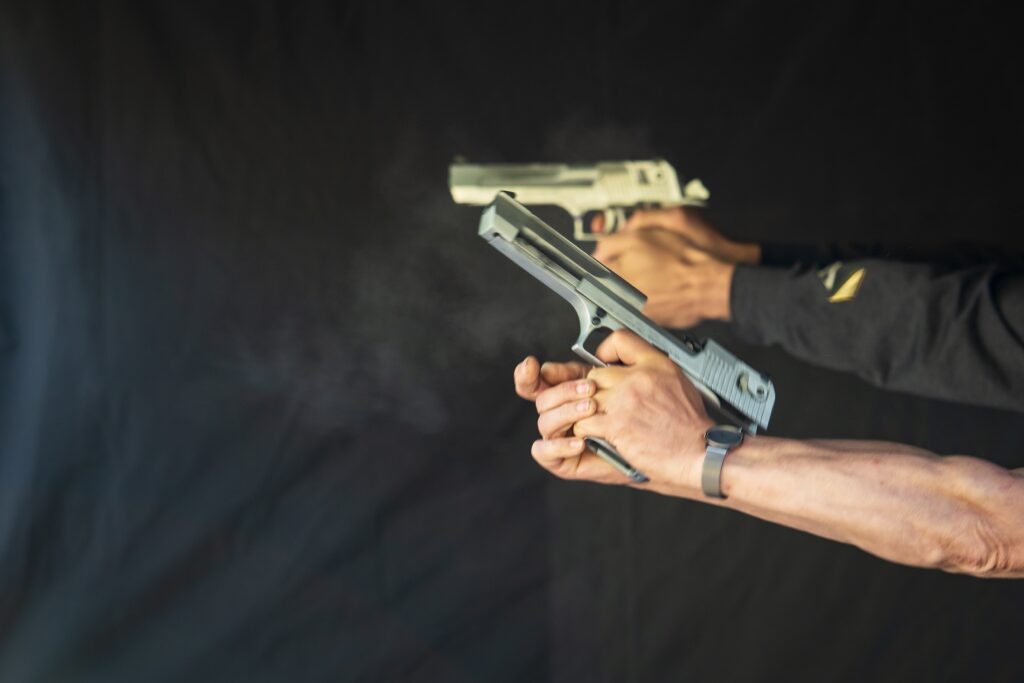
Muzzle control can also refer to recoil control. Recoil control depends on squeezing the grip hard with the support hand, and moderately with the shooting or strong side hand. The tighter that you grip with the support hand, the more the wrists will be able to resist flexing, the less the muzzle will rise, and the quicker the pistol will be back on target.
8. Follow-Through: The Shot Doesn’t End at the Trigger Break
Follow-through means continuing to apply the fundamentals throughout the firing cycle.
Maintain your grip and keep observing your sights. Allow the pistol to recoil without prematurely relaxing or changing your position.
Follow-through also provides valuable feedback.
What happened to your sights when the shot broke? Did the pistol move unexpectedly? Did your grip remain consistent throughout recoil?
These observations help identify areas needing improvement.
9. Recovery: Prepare for the Next Shot
Recovery completes the shooting cycle.
After recoil, reestablish a useful sight picture and maintain handgun control. Prepare for another shot when appropriate.
Effective recovery depends heavily on stance, grip, sight alignment, and follow-through.
When you apply those fundamentals consistently, the pistol tends to return to a predictable position.
Accuracy, consistency, and speed aren’t separate mysteries. They are interconnected results of applying the fundamentals correctly.
Why Must You Learn to Shoot Correctly Before Shooting Quickly?
Before performing a skill correctly at high speed, you must first learn to perform it correctly at a slower pace.
This principle applies to almost every learned physical skill.
A concert pianist doesn’t begin by playing a difficult composition at full speed. Professional athletes also build correct movement patterns before increasing speed.
Pistol shooting is no different.
During initial practice, perform movements slowly enough to recognize errors and make corrections.
Each correct repetition helps reinforce the desired movement patterns. Through deliberate practice, those patterns become increasingly familiar and automatic.
As performance improves, gradually increase speed without sacrificing accuracy, consistency, or control.
The objective is to practice correctly until the movements become automatic. Then progressively perform those movements faster.
Increasing speed before establishing correct technique often reinforces mistakes instead of eliminating them.
Even accomplished shooters can develop subtle inefficiencies. This explains why experienced shooters still benefit from professional instruction.
Why Doesn’t Firing More Ammunition Automatically Make You Better?
 Imagine a shooter who visits the range and fires 200 rounds. Some shots hit the intended target area. Others don’t.
The shooter adjusts something, fires another magazine, and hopes for better results. But what caused those misses?
Was it the grip, sight alignment, trigger control, or anticipation of recoil? Perhaps several mistakes contributed.
Without sufficient knowledge or useful feedback, the shooter may never identify the actual problem. Worse, repeating incorrect techniques can reinforce the habits that need correction.
These are among the common firearms training mistakes that can prevent meaningful improvement.
At an illustrative ammunition cost of 25 cents per round, 1,000 rounds cost $250. Five thousand rounds cost $1,250. Those figures exclude range fees, targets, and travel.
That’s an expensive way to repeat mistakes.
A knowledgeable instructor can identify problems, explain their causes, and establish a productive practice process.
Professional pistol instruction can substantially reduce unnecessary guesswork.
However, even excellent instruction cannot eliminate the need for repetition. That’s where dry fire becomes especially valuable.
Does Dry Fire Practice Really Improve Pistol Shooting?
Yes. Properly structured dry fire can improve important pistol shooting skills.
These include consistency, sight management, trigger operation, presentation, and control.
Dry fire allows shooters to rehearse skills without consuming live ammunition.
Furthermore, it makes frequent practice practical.
Most people cannot visit a shooting range every day. Work, family commitments, travel, range fees, and ammunition expenses create obvious limitations.
Short, focused sessions can provide valuable additional repetitions between live-fire range visits.
However, conventional dry fire doesn’t reproduce the complete shooting experience.
There is no ammunition-induced recoil. The slide generally doesn’t cycle.
Many striker-fired pistols also require manually cycling the slide between dry-fire trigger presses.
This can unintentionally establish an undesirable habit.
I’ve personally observed shooters who practiced conventional dry fire reach toward their slides during live fire.
The lesson is important: Repeated actions can become habits, whether those actions are desirable or not.
Effective practice must reinforce correct techniques and appropriate behaviors.
Why Does Recoil Feedback
Matter During Dry Fire?
Traditional dry fire offers substantial benefits. However, recoil introduces another important training dimension.
During live fire, the pistol moves and the sight picture changes. Shooters must recover control before attempting another accurate shot.
Consequently, recoil management, follow-through, and recovery deserve consistent practice.
The CoolFire Trainer recoil-enabled dry fire system helps bridge the gap between conventional dry fire and live fire.
Instead of requiring a separate simulated pistol, CoolFire converts a compatible real handgun into a CO2-powered training system.
The system replaces the firearm’s live-fire barrel and certain recoil components.
You continue using your actual pistol, including its grip, trigger, sights, and familiar controls.
When you press the trigger, CO2 cycles the slide and produces simulated recoil.
The system also reproduces normal trigger-reset behavior more closely than conventional dry fire requiring manual slide operation.
An optional laser provides additional feedback. It indicates where the pistol was directed when the trigger activated.
Combined, these features allow shooters to observe grip consistency, sight behavior, follow-through, recoil response, and recovery.
Simulated recoil isn’t identical to live ammunition. Therefore, dry fire cannot completely replace live-fire verification.
Nevertheless, CoolFire brings important parts of the shooting cycle into regular practice without consuming ammunition.
How Much Does Recoil-Enabled
Dry Fire Training Cost?
After purchasing the equipment, CoolFire’s ongoing practice costs can be substantially lower than live ammunition costs.
Consider a CO2 refill costing approximately $10 and providing 2,500 training shots.
The gas costs approximately four-tenths of one cent per trigger press.
Consumable striker tips require occasional replacement. Even with those expenses, ongoing costs can remain approximately one cent per repetition.
Actual costs depend on refill prices, equipment configuration, temperature, and consumable life.
By comparison, 2,500 rounds of live ammunition at 25 cents each would cost $625.
The difference becomes significant when shooters practice thousands of repetitions.
However, saving money isn’t the most important advantage.
The real benefit is making frequent, purposeful practice affordable and convenient.
How Often Should You
Practice Pistol Shooting?
Consistent, purposeful practice generally produces better results than occasional sessions filled with poorly evaluated repetitions.
Rather than working on everything simultaneously, concentrate on one aspect of performance.
Understand the skill. Recognize correct performance. Identify mistakes and make corrections.
Then evaluate your progress.
Use structured dry-fire practice between range visits. Return to live fire regularly to verify your results.
Private live-fire pistol training offers individualized feedback and an opportunity to evaluate shooting performance.
Always follow the training equipment manufacturer’s instructions.
Establish a dedicated practice area and remove live ammunition. Verify the firearm’s condition and maintain a safe muzzle direction.
Continue following firearm-safety rules throughout every training session.
The objective isn’t to accumulate the largest number of trigger presses.
Instead, accumulate correct repetitions that produce measurable improvement.
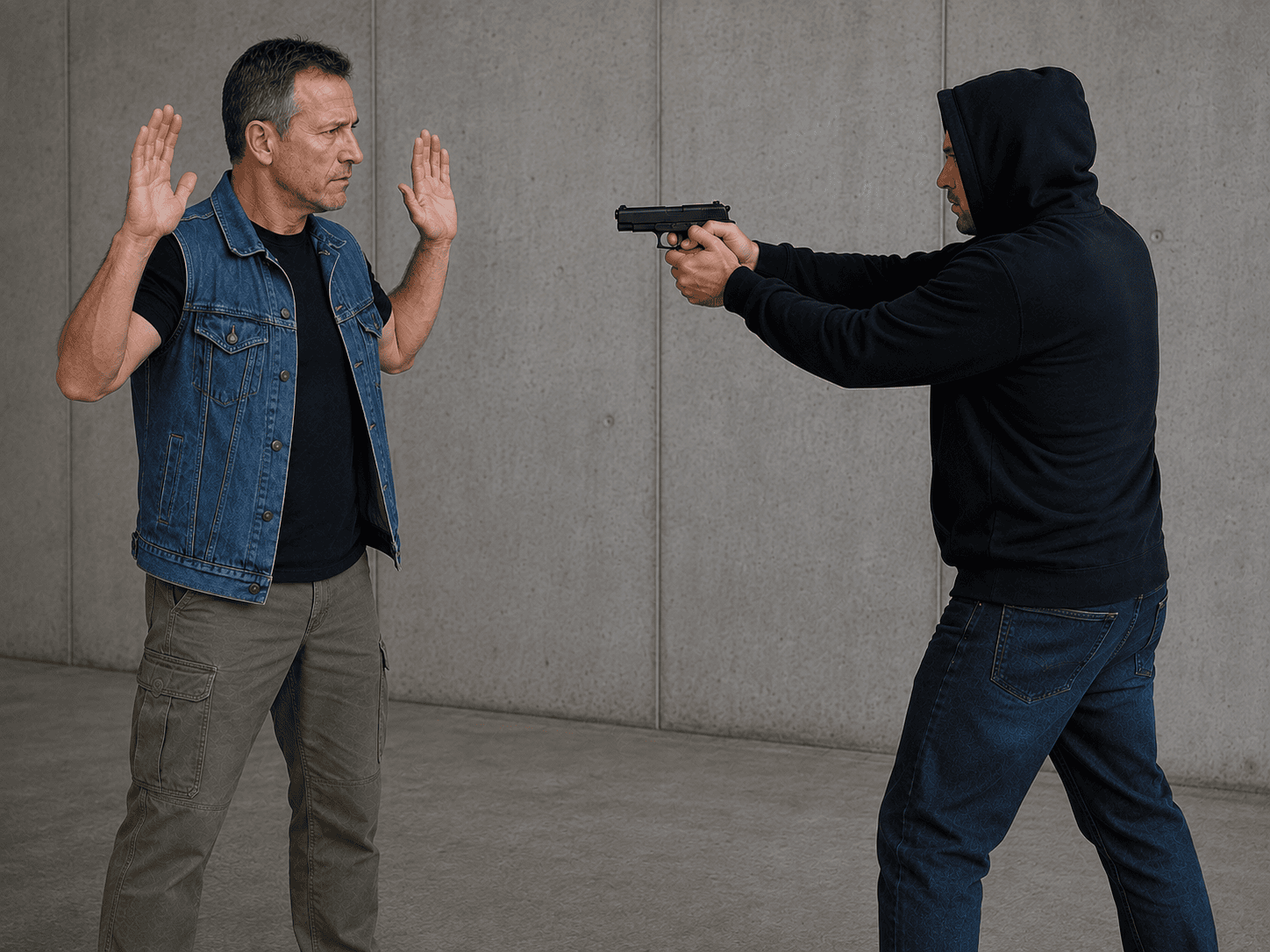
Does Accurate Target Shooting Mean You’re Ready for Self-Defense?
Not necessarily.
Accurate marksmanship matters. However, defensive competence involves much more than hitting a paper target.
Judgment, awareness, safe firearm handling, decision-making, and legal knowledge are additional responsibilities.
Important differences also exist between competition shooting and defensive shooting.
For these reasons, self-defense readiness cannot be measured solely by range accuracy.
Someone may legally carry a firearm without possessing sufficient practical skills for an emergency.
Understanding the difference between being armed and being trained is essential for anyone carrying a handgun for protection.
Becoming a Great Shooter Is a Process, Not an Accident
There is no magic shortcut to becoming a great pistol shooter.
No single lesson, training device, or afternoon at the range produces complete mastery.
Even accomplished shooters continually refine their fundamentals.
The process remains the same.
Learn the fundamentals. Understand correct performance. Practice deliberately. Recognize mistakes. Make corrections. Repeat.
Develop consistency before increasing speed.
Use feedback to measure improvement instead of relying on guesswork.
Professional instruction provides knowledge and direction. Regular practice develops physical skills.
Meanwhile, recoil-enabled dry fire makes realistic, frequent repetitions more accessible.
Live-fire training remains essential for validating performance under actual shooting conditions.
Great shooters aren’t born. They’re trained.
Becoming a great pistol shooter isn’t hit or miss.
It’s a process. And the process starts with the fundamentals.

He is the owner and chief instructor of CCW Training Academy, providing firearms training throughout North Central Florida.
Affiliate Disclosure: This article contains an affiliate link. CCW Training Academy may earn a commission from qualifying purchases.