
A Complete Range Safety Guide
The best eye and ear protection for shooting is not one particular product. It is a combination that has a verified protective rating, fits correctly, works with your firearm, and remains comfortable enough that you will wear it throughout every range session. For the rest of your range kit, use this broader Florida concealed carry safety-gear checklist.
For most shooters, that means impact-rated shooting glasses plus properly fitted earplugs, earmuffs, or electronic in-ear protection. At an indoor range, plugs worn under muffs are often the prudent choice because gunfire produces extremely intense impulse noise and indoor surfaces reflect that energy back toward the firing line.
The equipment also has to work as a system. Thick glasses can break the seal of earmuffs. Large ear cups can interfere with a rifle stock. Muffs can become hot and uncomfortable. Electronic earbuds can solve some of those problems, but their controls, fit, batteries, and phone apps introduce others.
This guide explains those tradeoffs without telling you that one brand or one design is best for everyone.
Quick range-safety answer: Wear verified impact-rated eye protection and genuine hearing protection whenever firearms are being discharged—even if you are only observing. Review the training locations and range requirements before arriving, and always follow the range’s rules. For indoor shooting and other high-impulse conditions, seriously consider properly inserted plugs under well-sealed muffs.

Why Hearing Protection Became Personal for Me
When I turned 18, I was legally old enough to buy my first pistol. It was a .22 LR target pistol with a heavy barrel—one of those older designs that was notoriously difficult to clean and reassemble.
The gun store had an indoor range downstairs. At the firing line, I fired about 400 rounds without hearing protection. Whether I wore eye protection, I cannot remember. Nor do I remember seeing a range safety officer.
When I finished, I packed my gear and got into the car. I started the engine and could barely hear it. Then I turned on the radio and realized I was almost completely deaf. My ears and head felt as though they were under pressure for the next four, five, or six days. My hearing gradually seemed to return, but that experience made the danger real in a way no warning label could.
The next protective equipment I bought was a pair of passive earmuffs.
My hearing seemed to recover to a functional level; that does not prove no permanent injury occurred. Noise injury can accumulate even when hearing appears normal afterward. If you experience sudden hearing loss, persistent muffling, pressure, pain, or ringing after gunfire, stop exposing yourself to more noise and obtain prompt medical advice.
A Gunshot Is Not Ordinary Noise
Firearms create brief, high-intensity impulse noise. NIOSH reports that firearm impulses can reach approximately 170 to 180 decibels sound-pressure level or higher. Impulse noise can cause immediate acoustic trauma and is more likely to cause noise-induced hearing loss than continuous noise containing the same energy.1
Another CDC-indexed review places typical recreational firearm peaks at approximately 140 to 175 decibels. The actual risk changes with the firearm, ammunition, muzzle device, shooting position, number of shots, nearby shooters, indoor or outdoor environment, and fit of the hearing protector.2
That is why “It is only a .22” and “I am only firing one round” are poor reasons to skip protection.
Hearing protection does more than prevent discomfort. It can help a student concentrate on instruction instead of anticipating the blast. That advantage matters during a beginner’s first pistol lesson, when the student already has several new skills to process. Electronic protection can also preserve communication and awareness while the passive structure of the device reduces hazardous sound.
Comparing Shooting Hearing Protection
| Type | Advantages | Disadvantages | Often works well for |
|---|---|---|---|
| Foam earplugs | Inexpensive, compact, high labeled ratings are available, no interference with rifle stocks or glasses | Protection depends heavily on correct insertion; harder to hear speech; easy to lose | Backups, doubling under muffs, hot weather |
| Reusable passive plugs | Compact, quick to reuse, no headband or ear-cup pressure | Fit varies by ear; must be cleaned; may provide less attenuation than a correctly fitted foam plug | Outdoor practice, range-bag backups |
| Passive earmuffs | Easy to see and put on, consistent positioning is easier to check, no batteries | Hot, bulky, may clamp tightly, may interfere with rifle cheek weld, glasses can compromise the seal | New shooters, observers, short sessions |
| Electronic earmuffs | Range commands and conversation remain audible; easy to put on; useful for instruction | Heat, clamping pressure, rifle interference, batteries, controls, and usually more bulk | Classes, handgun practice, instructors |
| Electronic in-ear protection | Low profile, cooler in summer, compatible with rifles and glasses, preserves communication | Fit and charging matter; small parts are easy to lose; touch controls and apps can frustrate users | Rifle shooting, long sessions, hot weather |
| Plugs under muffs | The strongest practical combination for many high-impulse settings | More equipment, reduced speech audibility unless electronic muffs are used, still depends on proper fit | Indoor ranges, loud firearms, instructors and frequent shooters |
There is no universal winner. A person shooting a rifle outdoors in summer has different needs from a first-time handgun student at an indoor range.
Electronic Earmuffs: Useful,
but Not Automatically More Protective
Electronic earmuffs are popular because they allow normal sounds to pass through—or amplify them—so the wearer can hear conversation and range commands. When a gunshot occurs, the electronics limit or shut down the amplified sound, depending on the design.
The electronics do not magically add protection to the Noise Reduction Rating. The physical ear cups, cushions, internal materials, and seal provide the labeled attenuation. Electronic features primarily improve awareness and communication.
That distinction matters because many low-profile electronic muffs have modest NRR labels. Their slim design may make handgun shooting and storage convenient, but the same slimness can involve a protection tradeoff compared with larger passive muffs.
Why I Moved Away from Muffs
Over the last 10 or 15 years, I purchased several pairs of high-end electronic muffs, including low-profile equipment intended to fit under a military helmet. I could not get comfortable shooting a rifle with them.
The cups interfered with the rifle, the headband made my head feel as though it were in a vise, and the muffs became hot and sweaty. I even replaced the original cushions with gel pads. They helped, but they did not solve the fundamental problems for me.
Someone else may love that same format. My experience is why a comparison should address firearm fit and comfort—not merely specifications on a box.

Electronic Shooting Earbuds: My Preferred Format
Electronic in-ear hearing protection solved the heat, clamping, and rifle-clearance problems for me. It remains my preferred format.
My older pairs use small physical buttons or switches. I can locate and operate those controls by feel. Many newer models use touch pads, and I have found them much harder to control. I have purchased and returned multiple newer pairs because I could not reliably turn them on, adjust them, or make their companion apps work.
My older button-controlled earbuds are now deteriorating—the rubber is coming off—and I have not found a satisfactory replacement. That is a useful reminder that newer technology is not automatically an improvement.
Physical Buttons Versus Touch Controls
| Control style | Potential advantage | Potential drawback |
|---|---|---|
| Tactile buttons or switches | Easy to identify by feel; positive feedback; often usable without looking | Small buttons may be difficult with gloves; mechanical parts can wear |
| Touch pads | Smooth exterior; potentially more functions | Accidental activation; uncertain feedback; difficult operation with sweat or gloves |
| Phone app | Detailed adjustments without manipulating a tiny earpiece | Pairing failures, updates, login requirements, poor connectivity, or an unavailable phone |
Bluetooth may permit phone-based adjustment, calls, or music during a break. Treat that as convenience, not protection. Calls and entertainment should never obscure range commands or distract anyone on an active firing line.
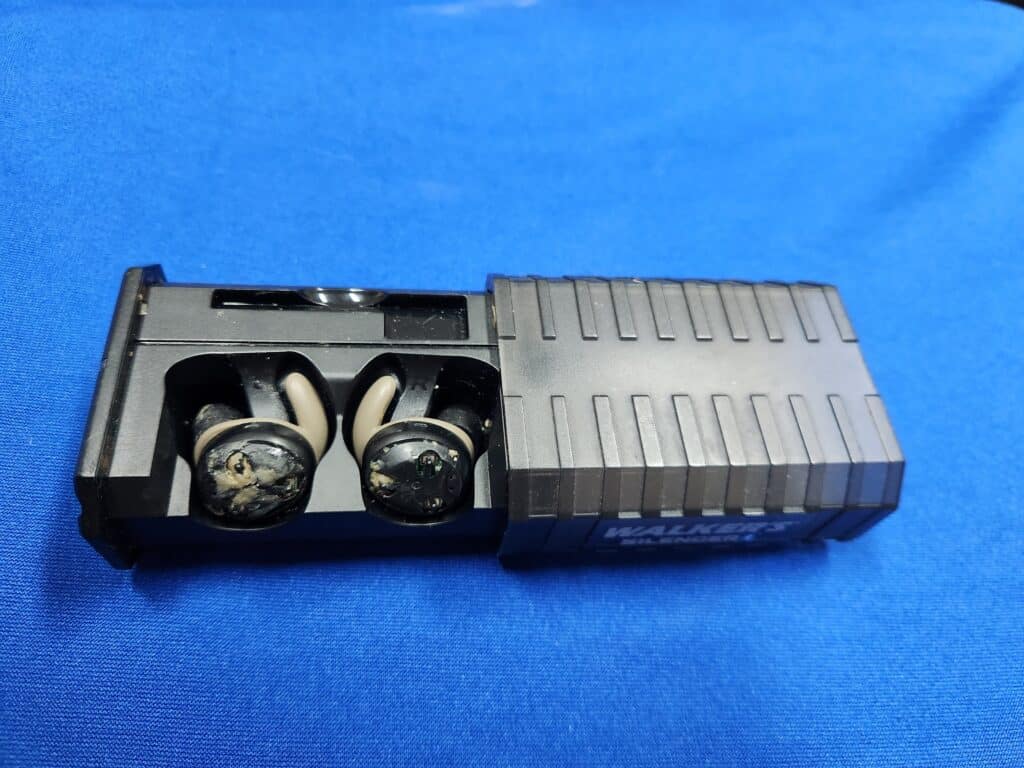
These are my in-ear electronic earbuds with small push button switches that are easy to use. As you can see, they are so old that the rubber has dried and fallen off. However, they still work.
Passive Earplugs Still Deserve
a Place in the Range Bag
A correctly fitted foam earplug can provide excellent protection for very little money. The words “correctly fitted” are the critical part.
For a roll-down foam plug, clean hands, compress the plug into a narrow cylinder, reach over the head to straighten the ear canal, insert it deeply, and hold it while the foam expands. Follow the manufacturer’s directions because designs vary. A plug sitting loosely at the entrance of the ear may provide far less protection than its package suggests.
Reusable plugs must also fit the individual ear and remain clean and undamaged.
Do not improvise with tissue, cotton, empty cartridge cases, or other objects. I once rolled tissues into makeshift plugs during an unexpected law-enforcement demonstration. They seemed to reduce the blast, but they were not tested protection. The correct decision would have been to stop and obtain proper equipment.
Keep several fresh pairs of genuine earplugs in the range bag. They weigh almost nothing, cost little, and can rescue a session when batteries die or another shooter arrives unprepared. Equipment backups also prevent one of the common mistakes that disrupt gun-safety classes.


What NRR Means for Shooters
NRR stands for Noise Reduction Rating. It is a laboratory-derived label for hearing-protection devices. It is useful for comparing products, but it is not a promise that every wearer receives that many decibels of protection in every environment.
Real-world protection depends on:
- correct size and insertion of plugs;
- a complete earmuff seal around the ear;
- hair, hats, glasses, and other objects under the cushion;
- cushion condition and headband tension;
- the firearm and ammunition;
- muzzle brakes and barrel length;
- whether the range is indoors, outdoors, covered, or enclosed;
- the number of shots and nearby shooters.
OSHA cautions that laboratory attenuation is seldom achieved in the workplace and provides adjusted methods for estimating actual exposure.3 NRR was also developed around continuous-noise testing and does not perfectly describe every impulse-noise event.
Do Not Add the Ratings Together
If plugs are rated NRR 30 and muffs are rated NRR 25, the combination is not NRR 55. OSHA’s simplified dual-protection method starts with the higher-rated protector and adds only 5 decibels for the second device, with further adjustments depending on the noise measurement and field assumptions.3
For an individual shooter, fit is often more important than chasing the largest number printed on a package.
When Should Shooters Wear Plugs Under Muffs?
NIOSH recommends double hearing protection—earmuffs over earplugs—for impulse sounds and occupational noise exposures at or above 100 dBA.4 Its indoor-firing-range guidance specifically recommends double protection for workers and shooters who train regularly.5
That makes dual protection particularly sensible for:
- indoor ranges;
- rifles, short barrels, magnum firearms, and muzzle brakes;
- high-volume training;
- instructors, RSOs, and frequent shooters;
- anyone positioned near other shooters;
- situations in which the exact noise exposure is unknown.
Electronic muffs over plugs can restore some ability to hear speech and commands, although the plugs will still reduce what reaches the ear. Our tactical firearms training tools page explains how protective equipment fits into a larger training system.
The Best Shooting Glasses Are Verified
—Not Merely Plastic
Many products marketed as “safety glasses,” “shooting glasses,” or “tactical glasses” are simply eyewear with plastic lenses. Plastic does not automatically mean protective.
Even polycarbonate is a type of plastic. It is widely used in legitimate protective eyewear, but lens material alone does not prove that a particular pair passed an impact test. The lenses, frame, retention, coverage, and complete assembly all matter.
Look for the applicable marking on the product and verify the manufacturer’s documentation. Do not substitute vague descriptions such as “shatterproof,” “impact resistant,” or “tactical” for a recognized rating.
Z87 and Z87+
ANSI/ISEA Z87.1 is the American standard governing occupational and educational eye and face protection. On non-prescription protectors, Z87 and Z87+ do not mean the same thing: the plus marking identifies eyewear that meets the standard’s high-impact requirements. Prescription safety eyewear uses its own marking conventions, so ask the optician to explain the markings on the complete assembly.
Military ballistic specifications such as MIL-PRF-32432 involve different tests and should not be casually treated as interchangeable with ANSI markings. If a manufacturer claims compliance, confirm the exact model and documentation.
For shooting, also evaluate:
- coverage at the front and sides;
- secure fit during movement;
- optical clarity and distortion;
- clear lenses for indoor or dim conditions;
- suitable tint and ultraviolet protection outdoors;
- anti-fog performance;
- temple thickness under earmuffs;
- compatibility with your prescription and shooting position.


Glasses Can Compromise an Earmuff Seal
NIOSH specifically warns that safety glasses worn under muffs can create an acoustical leak and reduce the protector’s performance.5
This does not mean removing the glasses. It means choosing the two products together.
Use thin, low-profile temples when possible. Put the glasses on first, seat the muffs completely around the ears, and check for visible gaps or uneven cushion pressure. Hair, hats, and earrings can create similar problems. Replace cushions that have hardened, cracked, or permanently compressed.
If you cannot maintain a good muff seal with necessary eyewear, properly fitted in-ear protection may avoid the conflict. Indoor shooters may still need to double up, so select the thinnest compatible glasses temples and verify the fit of the entire system before entering the firing line.


Prescription Shooting Glasses:
Tell the Eye Doctor What You Need to See
Prescription shooting eyewear deserves more thought than ordering an everyday distance prescription in a sporty frame.
For iron sights, explain that the front sight is the critical visual reference and provide the approximate distance from your eye to the front sight in your normal shooting position. With a red-dot or another optic, explain the sighting system and the range of target distances you normally use. Discuss dominant eye, head position, indoor and outdoor lighting, and whether the glasses must fit under muffs.
Do not unexpectedly carry a working firearm into an optometrist’s office. Call first and follow the practice’s policy. Measurements, photographs, sight specifications, or an approved inert training replica may provide what the doctor needs. If the practice specifically arranges to inspect the firearm, comply with all applicable laws and every safe-handling requirement.
Ask about polycarbonate lenses and a complete frame-and-lens assembly carrying the appropriate impact marking. Ordinary prescription glasses—even those with plastic or polycarbonate lenses—are not automatically rated shooting protection.
Why I Buy Titanium Frames
I personally buy titanium frames. They cost considerably more up front, but they are light, comfortable, and extremely difficult to break in ordinary use. I have repeatedly had new prescription lenses installed instead of replacing the complete pair whenever my prescription changed.
I owned one pair of titanium-framed sunglasses for more than 20 years. They did not wear out. I accidentally left them in a restaurant. When I replaced them, the new frames felt dramatically lighter—perhaps 80 or 90 percent lighter by my unmeasured impression. That helped me get over losing the originals.
I currently keep three titanium frames in service: clear prescription glasses and prescription sunglasses in the car, and another clear pair in the house. During training, they have been so light that I have stopped the RSO before starting the timer because I thought I had forgotten my glasses, only to discover I was already wearing them.
That is comfort you notice by not noticing it.
Titanium describes the frame material, not its protective rating. An optician should inspect an older frame before fitting new lenses, and the complete assembly still needs the proper rating for its intended use. Replace damaged eyewear after a meaningful impact. Follow the manufacturer’s storage guidance, especially when leaving eyewear in a vehicle exposed to heat, cold, or sunlight.
I use inexpensive “cheater” readers for ordinary close reading. Unless specifically marked and documented otherwise, those are reading aids—not shooting glasses.
Alt: Three durable prescription frames belonging to a firearms instructor, including clear glasses and sunglasses.
Caption: My three-frame system: prescription sunglasses, a clear travel pair, and a clear pair kept at home. I replace the lenses when my prescription changes instead of replacing the durable Titanium frames.


| Situation | Practical starting point | Pay special attention to |
|---|---|---|
| First indoor-range visit | Rated clear glasses, correctly fitted plugs, and muffs over them | Instructor communication and glasses/muff seal |
| Outdoor handgun practice | Rated glasses plus well-fitted plugs, muffs, or electronic in-ear protection | Sun, wind, nearby shooters, and duration |
| Rifle practice | Rated glasses plus low-profile in-ear protection or rifle-compatible muffs | Cheek weld and stock interference |
| Group live-fire training class | Rated glasses plus electronic protection; double up when conditions warrant | Hearing commands, batteries, all-day comfort |
| Hot-weather practice | Rated glasses plus properly fitted plugs or electronic in-ear protection | Sweat, seal, hydration, and device retention |
| Prescription wearer | Complete rated prescription assembly designed for the visual task | Front-sight distance, optic use, temple thickness |
| Instructor or RSO | Dual protection suited to prolonged exposure, often with electronic muffs | Communication, repeated exposure, spare batteries and plugs |
These are starting points, not guarantees for every exposure. Range rules, equipment instructions, qualified guidance, and actual fit control.
A 60-second Fit Check Before the Firing Line
- Inspect the glasses. Confirm the marking, clean the lenses, and look for cracks, deep scratches, loose parts, or damaged temples.
- Fit the plugs. Insert them according to the manufacturer’s directions. If foam plugs are being used, give them time to expand.
- Seat the muffs. Center each cup around the entire ear and check the cushion seal.
- Check interference. Look for gaps caused by glasses, hair, hats, jewelry, or mask straps.
- Shoulder the firearm while unloaded and in a safe location. Confirm that muffs do not interfere with the stock or normal head position.
- Test electronic controls. Verify power, volume, left/right operation, and batteries before live fire.
- Carry backups. Keep genuine foam plugs and spare batteries in the range bag.
- Keep protection on. Do not remove it merely because you are finished shooting while others remain on the line.
Frequently Asked Questions
What Eye and Ear Protection
Do I Need at a Gun Range?
At minimum, use verified impact-rated shooting glasses and genuine hearing protection whenever firearms are being discharged. The range may impose additional requirements. Indoor ranges and other high-impulse settings often justify plugs under muffs.
Are Electronic Earmuffs Better Than Passive Earmuffs?
Electronic muffs are better for communication and awareness, but not automatically for attenuation. Compare the labeled rating, seal, fit, comfort, and firearm compatibility. Passive muffs may offer excellent protection without batteries, while electronic models can make instruction easier.
Are Electronic Shooting Earbuds as Good as Earmuffs?
They can be the better format for some shooters because they avoid heat, head pressure, glasses interference, and rifle-stock contact. Their actual suitability depends on the verified rating, individual ear fit, condition, and shooting environment. Indoor shooting may still warrant muffs over properly fitted in-ear protection.
Can I Use Ordinary Earbuds or Noise-canceling Headphones at the Range?
Not as a substitute for genuine shooting hearing protection. Consumer music earbuds and active-noise-canceling headphones are designed for listening and continuous ambient noise, not necessarily firearm impulse noise. Use a device specifically labeled and documented as hearing protection.
Is 22 or 23 NRR Enough for Shooting?
There is no universal NRR that makes every firearm and range condition safe. A modestly rated device may be used by many outdoor shooters, but indoor ranges, rifles, muzzle brakes, high volume, nearby shooters, and imperfect fit increase concern. Double protection is often the better approach for impulse noise.
Can I Wear Ordinary Prescription
Glasses at the Range?
Ordinary prescription glasses correct vision but are not automatically safety eyewear. Use a complete prescription safety assembly carrying the appropriate markings, or properly rated over-glasses protection that does not disturb fit. Ask an optician familiar with protective eyewear.
What Lens Color Is Best for Shooting?
Clear lenses are the straightforward choice indoors and in dim conditions. Outdoors, the useful tint depends on light, background, target, and personal vision. Impact rating, coverage, clarity, and fit matter more than fashionable lens color.
How Often Should Shooting Protection Be Replaced?
Inspect it before use and follow the manufacturer’s instructions. Replace cracked, deeply scratched, distorted, loose, contaminated, or impact-damaged glasses. Replace hardened earmuff cushions, degraded foam tips, and any hearing protector that no longer seals or functions reliably.
The Bottom Line
The best shooting eye and ear protection is equipment you can verify, fit correctly, and wear consistently.
Do not confuse plastic lenses with rated eye protection. Likewise, never confuse electronics with additional attenuation. You also cannot add two NRR labels together. Finally, do not let fashion, Bluetooth, or impressive marketing distract from fit and documented performance.
For many shooters, especially indoors, the dependable combination is simple: rated glasses, properly fitted plugs, and well-sealed muffs. For rifle shooting, hot weather, and long sessions, electronic in-ear protection may be more practical—provided it fits and carries a suitable verified rating.
Buy for the way you actually shoot. Test the complete system before the firing line. Keep backups nearby. Your eyes and hearing do not come with replacements.
About the Author

Alan B. Densky
Alan B. Densky is a former deputy sheriff, Florida concealed carry instructor, and founder and lead instructor of CCW Training Academy. His certifications include NRA Certified Pistol Instructor, NRA Home Firearms Safety Instructor, NRA Range Safety Officer, Nationwide Concealed Carry Instructor, and IDPA Safety Officer.
Alan teaches private, in-home, live-fire, and scenario-based defensive pistol training throughout North Central Florida. His instruction emphasizes firearm safety, simple repeatable skills, responsible decision-making, and techniques that work under real-world stress.
Related Firearms Training and Safety Resources
- Florida Concealed Carry Safety Gear
- Beginner Pistol Training: What to Expect From Your First Pistol Lesson
- Private Live-Fire Pistol Training
- Group Live-Fire Pistol Training
- Gun Safety Classes: Avoid Common Training Mistakes
- Training Locations and Range Requirements
Sources
- National Institute for Occupational Safety and Health, How Can We Measure Impulse Noise Properly?
- CDC Stacks, Prevention of Noise-Induced Hearing Loss from Recreational Firearms
- Occupational Safety and Health Administration, OSHA Technical Manual: Noise
- National Institute for Occupational Safety and Health, Provide Hearing Protection
- National Institute for Occupational Safety and Health, Take Aim at Protecting Yourself: Indoor Firing Ranges