
Start Your Pistol Training Florida
Journey in the Right Place
Pistol training Florida works exactly like martial arts. White Belt. Blue Belt. Black Belt. Every level builds on the one before it, and there are no shortcuts. You never get more than you invest — not in skill, not in time, and not in money.
If you go looking for a discount Black-Belt, reality will turn your Black-Belt into a White-Belt when it is needed the most.
Quick Guide to Courses
- Permitless Carry – Florida law allows permitless carry, but you must still meet all the same qualifications as a Concealed Weapons License holder.
- Concealed Weapons Permit – Why a permit still matters in a permitless state
- Beginner Pistol Small Group Co‑Ed Class
- Women Only Beginner’s Pistol Small Group Class
- Beginner Through Advanced Pistol Training – Fix bad habits before they become permanent, or eliminate them if they already are
- Tactical Pistol I – Your first step into real‑world defensive shooting
- Tactical Pistol II – Intermediate/advanced scenario‑based training
- Ongoing Maintenance: The CCW Challenge – Stay sharp, confident, and ready
- Home Defense Weapons Training – 78% of all attacks happen in the home!
Concealed Weapons Permit
Even though Florida is a permitless state, there are still many benefits to having a CWL that are not available when carrying permitless. Here are just a couple:
- Driving through a school zone without a permit is a federal offense.
- You skip the 3‑day waiting period on firearm purchases.
- Your Florida CWL is recognized in 37 other states.
- IN-YOUR-HOME PERMIT CLASSES
- 4-Hour Basic Permit Class
- Learn More
- 8-Hour Advanced Permit Class
- Learn More
- Prices & Schedule For In-Your-Home Permit Classes
- GROUP PERMIT CLASSES AT OUR LOCATION
- 4-Hour Basic Permit Class
- Learn More
- 8-Hour Advanced Permit Class
- Learn More
- Prices & Schedule For Group Permit Classes
Both in-home and group training options lead to the same high-quality certification — and both paths lead to the registration page.
Beginner Through
Advanced Pistol Training
Fix Bad Habits Before They Become Permanent
- Basic Pistol Classes (Private or Group) Learn the fundamentals correctly — stance, grip, sight alignment, sight picture, trigger control, recoil management, follow-through, recovery, and safe gun-handling.
- Choose the training format that fits your comfort and learning style.
- Learn More
- Prices & Schedule For Private In-Your-Home Training
- Prices & Schedule For Private On The Range Training
Women Only Beginner’s Pistol Group Class
- This women’s beginner class gives new shooters a calm, supportive place to learn the essentials before moving on to more advanced training.
- No experience needed; loaner firearm option available
- Reasonably priced
- Learn More
- Scheduling & Pricing
Co-Ed Beginner’s Pistol Group Class
- This beginner class gives new shooters a calm, supportive place to learn the essentials before moving on to more advanced training.
- No experience needed; loaner firearm option available
- Reasonably priced
- Learn More
- Scheduling & Pricing
Tactical Pistol I
- Tactical Firearms Training for shooters who want to build a rock solid defensive foundation: Fast Draw & Fundamentals
- Learn More
- Prices & Registration The Next Tactical Pistol 1 Group Class
- We provide snacks and drinks for everyone for free!
- Prices & Schedule For Private In-Home Tactical Pistol I Or . . .
Tactical Pistol II
Tactical Pistol II is for experienced shooters ready to push into scenario-based training for advanced defensive gunfighting. Fast, dynamic, mentally demanding, exciting and fun.
Learn More- Prices & Registration For The Next Tactical Pistol II Group Class
- We provide snacks and drinks for everyone for free!
- Prices & Registration For Private In-Your-Home Tactical Pistol II
Ongoing Maintenance: Tactical Pistol III
The CCW Self-Defense Challenge & Skills Competition
Serious Shooters Don’t Stay Sharp by Accident
Monthly defensive pistol competition with timed scenarios and real‑world self‑defense challenges to keep your skills sharp.
Home Defense Weapons Training
- 78% of all violent attacks happen inside the home.
- Train inside your actual home using real pistols modified with the CoolFire Trainer for safe, realistic, scenario‑based home‑defense practice.
- Learn More
- Prices, Schedule
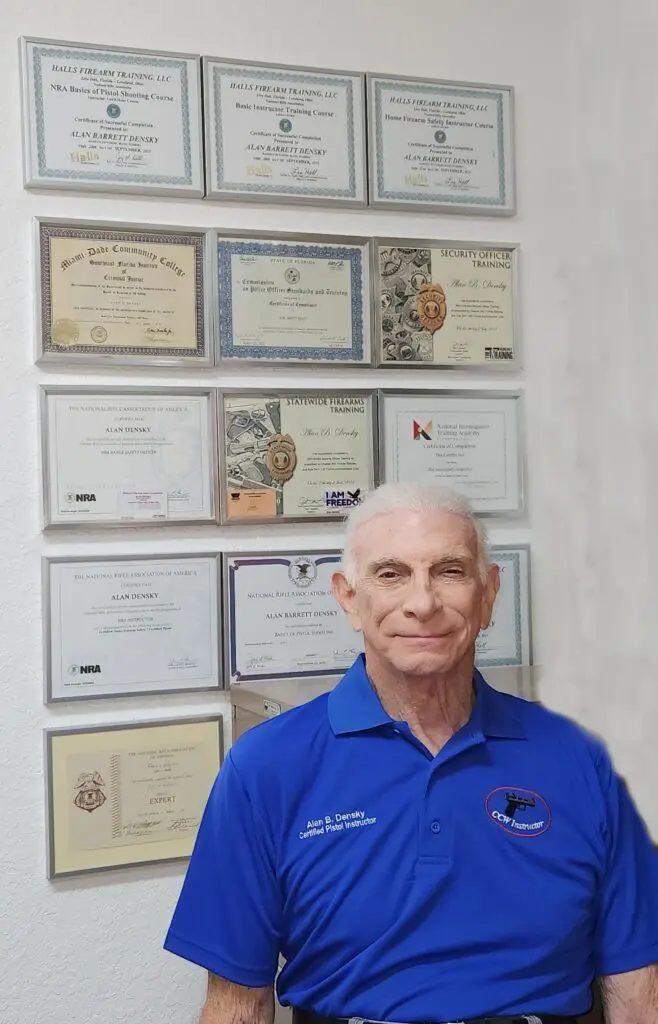
Alan B. Densky is NRA Certified and can teach
NRA Courses.
Above Are Non-NRA Courses
The training programs listed on this page are Non-NRA Courses — they are advanced classes that go far beyond the NRA Basic curriculum, and are designed for real-world defensive skill development.
Pistol Training In Florida
Florida’s permitless carry law changed who can carry a firearm. Yet, it did nothing to change the realities of violent encounters or the responsibilities that come with armed self‑defense.
Understanding those realities requires more than owning a pistol; it demands a structured path that builds skill, judgment, and confidence one layer at a time.
Carrying a firearm without pistol training in Florida creates a dangerous gap between what people believe they can do and what they can actually perform under stress.
Without Permit Training There Is A Gap
Recognizing that gap becomes the first step toward becoming a responsible, capable defender who can make sound decisions when seconds matter.
Most violent encounters unfold in tight spaces, low light, and extreme proximity. That means the average gun owner faces challenges they have never practiced for.
Situations involving multiple attackers, sudden ambushes, or rapid movement require skills that static range shooting simply cannot provide.
Every responsible adult who carries a firearm deserves a training path that mirrors real‑world conditions instead of relying on hope, luck, or assumptions.
CCW Training Academy delivers that path by offering a complete progression of pistol training in Florida. The progression starts at beginner “kindergarten” pistol skills. At the top of the progression is Tac III “doctoral‑level” defensive mastery.
Progressing through this ladder ensures that each student grows from basic safety and marksmanship into a confident, legally informed, tactically capable defender.
Nothing about this journey happens by accident; it develops through deliberate, structured, scenario‑based training. This type of training prepares you for the moment you hope never comes.
The Full Training Ladder
Beginners often arrive with uncertainty, hesitation, or fear. And that’s exactly why the first step focuses on safe, simple, judgment‑free instruction.
New shooters learn how their pistol works. Next, they learn how to handle it safely. And how to build the foundational habits that prevent accidents and create confidence.
Foundations matter because every advanced skill depends on a rock‑solid understanding of grip, stance, sight alignment, trigger control, and muzzle discipline.
Confidence grows quickly, once students realize they can control the gun, follow commands, and hit what they’re aiming at. They can do all of that, without feeling rushed or embarrassed.
Advancing from this “kindergarten” level sets the stage for the next phase. In the next phase, students begin learning the legal and tactical basics of carrying a firearm for self‑defense.
Permit‑level training introduces the realities of Florida law. For example, the boundaries of justified lethal force, and the responsibilities that come with carrying a gun in public. It is at this point that almost everyone who takes this class begins to take a sigh of relief regarding pistol training in Florida.
Legal Knowledge
Becomes A Critical Factor
Legal knowledge becomes a critical part of the training path. Why? Because misunderstanding the law can be just as dangerous as misunderstanding the gun.
Drawing from concealment, managing stress, and making accurate hits at realistic distances all begin at this stage. This stage is the forming the “grade school” level of defensive pistol skills.
Students quickly discover that static range shooting does not prepare them for real‑world violence. This is why the next step moves training into the environment where most attacks occur.
Homes become the battleground in the majority of violent encounters, and that reality drives the need for in‑home pistol training in Florida.
In‑Home Defensive Training
Training inside your actual home layout transforms theory into practical, personalized defensive skill.
Hallways, corners, doorways, and furniture create real obstacles that require real solutions, not abstract concepts.
CoolFire‑equipped pistols allow students to train with their own firearm, complete with recoil simulation and laser‑based shot placement, without any possibility of chambering live ammunition.
Movement through confined spaces becomes safer and more efficient when practiced in the same rooms you live in every day.
Angles, fatal funnels, and lines of fire become obvious once you see them in your own home instead of imagining them in a classroom.
Lighting conditions shift dramatically from room to room, and learning to manage those changes gives students a tactical advantage they cannot gain at a static range.
Multiple Attacker Scenarios
Multiple‑attacker scenarios become more realistic when practiced in hallways, kitchens, and living rooms where real threats are most likely to appear.
Decision‑making improves when students rehearse how to move loved ones to safety, how to use cover, and how to avoid exposing themselves unnecessarily.
Confidence grows rapidly because students finally understand how to defend the environment they are most responsible for protecting.
Graduating from in‑home pistol training in Florida prepares students for the next phase: private live‑fire instruction that sharpens accuracy, speed, and control.
Private Live‑Fire Skill Building
Private live‑fire training gives students focused, one‑on‑one coaching that accelerates skill development.
Recoil management improves when shooters receive immediate feedback on grip pressure, wrist alignment, and stance stability.
Accuracy under stress becomes easier to achieve once students learn how to break the shot cleanly while maintaining visual focus on the front sight or optic.
Drawstroke efficiency increases as shooters refine their movement from concealment, reducing wasted motion and shaving precious time off their first shot.
Transitions between targets become smoother when students learn how to drive the gun with their eyes instead of muscling it with their arms.
Reloads and malfunction clearing become second nature through repetition and coaching that corrects small errors before they become bad habits.
Movement Drills
Movement drills teach students how to step off the line of attack, use angles to their advantage, and maintain balance while shooting.
Cover usage becomes more effective when shooters learn how to minimize exposure and maximize protection without sacrificing accuracy.
Confidence builds because students see measurable improvement in every session, reinforcing the value of structured, professional training.
Advancing from private live‑fire instruction leads naturally into Tac I, where defensive shooting becomes a tactical discipline instead of a mechanical skill.
Tac I: High‑School‑Level Defensive Skills
Tac I introduces students to the realities of fighting with a pistol instead of simply shooting one.
Stress levels rise intentionally as students learn to draw, move, and shoot under time pressure.
Multiple‑target engagement becomes a core skill, forcing shooters to prioritize threats and maintain situational awareness.
Cover usage becomes more dynamic as students learn how to move into and out of protective positions while maintaining control of the gun.
Low‑light considerations enter the curriculum, teaching students how to identify threats, manage shadows, and avoid shooting at shapes they cannot confirm.
Decision‑making becomes more complex as scenarios introduce ambiguous situations that require judgment, not just marksmanship.
Accuracy expectations rise because defensive shooting demands precision, not just hitting the paper somewhere.
Movement patterns become more advanced as students learn how to create distance, break angles, and avoid standing still during an attack.
Confidence increases because students begin to understand how to apply their skills in realistic defensive situations.
Graduating from Tac I prepares shooters for Tac II, where the complexity and intensity of training increase significantly.
Tac II: College‑Level Defensive Mastery
Tac II pushes students into more demanding scenarios that require faster thinking and more refined technique.
Ambush drills force shooters to react instantly, draw efficiently, and deliver accurate fire before the threat closes distance.
Multiple‑attacker scenarios become more challenging as students learn how to manage angles, prioritize threats, and avoid getting flanked.
Low‑light and no‑light drills become more advanced, requiring shooters to identify targets, manage handheld lights, and maintain control under visual stress.
Movement becomes more aggressive as students learn how to fight while stepping, pivoting, or retreating without losing balance or accuracy.
Cover usage becomes more tactical as shooters learn how to slice the pie, minimize exposure, and maintain visual dominance over the threat area.
Decision‑making becomes faster and more accurate because students learn how to process information under pressure.
Accuracy expectations rise again because defensive shooting demands consistent performance, not occasional success.
Confidence deepens as students realize they can handle complex, fast‑moving scenarios with control and competence.
Graduating from Tac II sets the stage for Tac III and the CCW Self‑Defense Challenge, where ongoing maintenance becomes essential.
Tac III & The CCW Self‑Defense Challenge
Tac III represents the doctoral level of defensive pistol training, where shooters refine their skills through continuous, scenario‑based practice.
Monthly challenges introduce new problems, new environments, and new tactical puzzles that force shooters to adapt quickly.
Timed scenarios measure draw speed, accuracy, movement efficiency, and decision‑making under pressure.
Multiple‑attacker drills become more intense, requiring shooters to manage chaos while maintaining control of their gun and their surroundings.
Low‑light scenarios test visual discipline, target identification, and the ability to avoid shooting innocent people.
Movement patterns become more advanced as shooters learn how to fight through obstacles, navigate tight spaces, and maintain balance under stress.
Cover usage becomes instinctive because shooters practice it repeatedly in varied scenarios.
Decision‑making becomes sharper as students learn how to evaluate threats, avoid tunnel vision, and maintain situational awareness.
Scores posted on Practiscore allow shooters to track progress, identify weaknesses, and set goals for improvement.
Ongoing participation ensures that skills remain sharp, confidence stays high, and readiness becomes a permanent part of the shooter’s life.
Your Next Step
Choosing where to begin your pistol training in Florida at the CCW Training Academy, depends entirely on your current skill level, comfort level, and goals.
Beginners should start with foundational pistol training to build safety, confidence, and basic marksmanship.
Intermediate shooters benefit from permit‑level training, in‑home defensive work, or private live‑fire coaching.
Advanced shooters thrive in Tac I and Tac II, where defensive skills become tactical, dynamic, and realistic.
Experienced shooters maintain their edge through Tac III and the CCW Self‑Defense Challenge, where monthly scenarios keep skills sharp.
Everyone who carries a firearm deserves a training path that builds real‑world readiness instead of relying on hope or luck.
CCW Training Academy provides that path from kindergarten‑level basics to doctoral‑level defensive mastery.
Progress begins with a single decision: choosing the training level that matches where you are today.
Commitment to that decision builds the skills that could save your life or the life of someone you love.
Starting now ensures you never face a violent encounter unprepared.